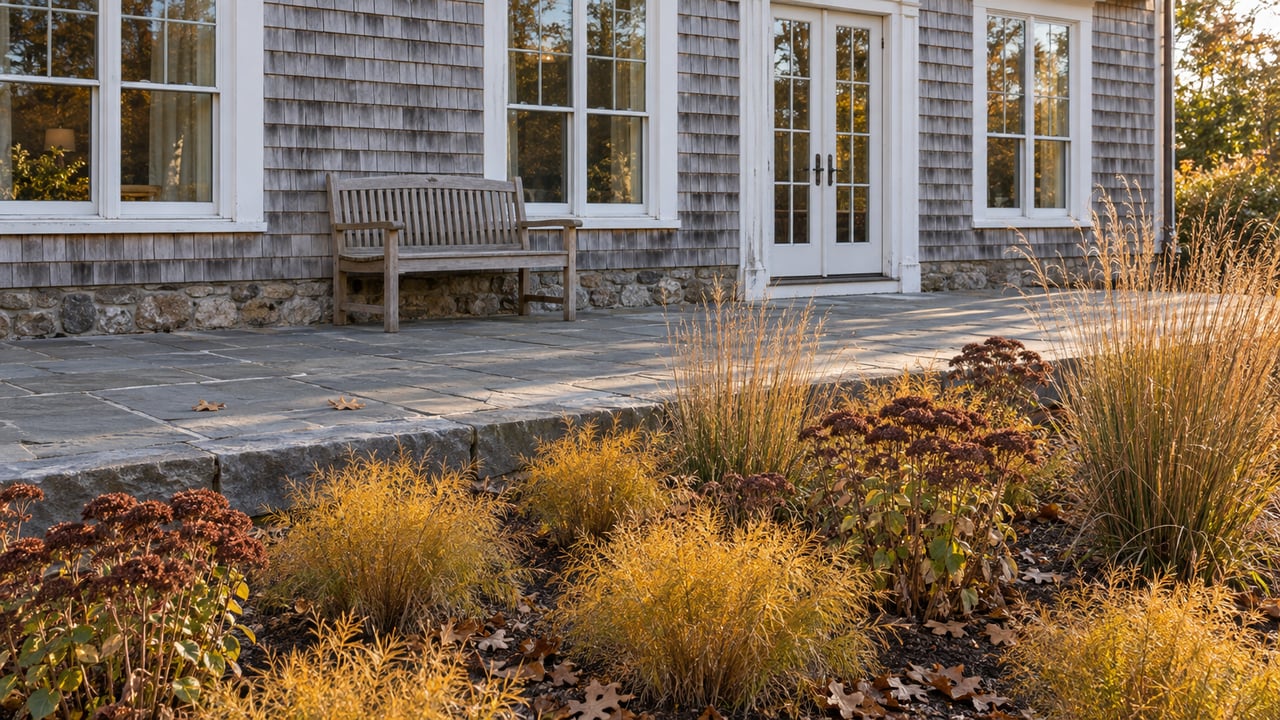
"Brown is a color too!" Piet Oudolf likes to say this, according to Peter Slothower, the curator who has looked after the new Oudolf Garden at Planting Fields through its first season of growth. He used the line in a September post on the Planting Fields Foundation's site to describe what visitors would find in the garden's first weeks. The garden opened on October 17. Most public gardens are winding down by then. This one was planned so that the browns, tans and beiges of late fall belong to the design, and so do the dried seedheads that come after.
Planting Fields sits inside the Village of Upper Brookville. The new acre is designed to change week by week through winter, and the estate gets cheaper and calmer to visit in exactly those weeks.
An acre centered on a 120-year-old arbor
The garden is laid out around the Rose Arbor. Landscape designer James Greenleaf built it for the Byrne family around 1906, before the Coe family bought the property in 1913. Foundation archive photos show a young Henry Coe there with his mother, Mai Coe, in 1921. Oudolf's plan puts the arbor at the center of his acre. As part of the project, the Foundation is restoring it with 31 new custom-designed arbors and added plantings for seasonal interest.
The Foundation calls the garden the most significant addition to the property since the Olmsted Brothers finished their work there in the 1930s. It is Oudolf's first public garden on Long Island and his first public garden in New York in more than a decade, after the High Line and the Battery. The Foundation's July 21 release counts more than 25,000 plants and grasses from over 100 species. The work moved quickly. Crews began preparing the quadrants around the arbor in fall 2025, shaped beds, paths and berms in early spring, and started planting in June. In February, Long Island Press reported a $100,000 grant from Bank of America toward the garden.
Slothower explained the design to Newsday in one sentence: "It is made by the people, for the people." Foundation President and CEO Dr. Gina J. Wouters said in the release that the garden is meant "to be explored, learned from, and returned to throughout the seasons." That idea of coming back again and again shapes how the garden is meant to be seen.
What the garden does between now and spring
Slothower's post A Garden for All Seasons goes through the year one season at a time. Here is what he describes for the months ahead.
| When | What the curator expects |
|---|---|
| Late October into frost | A few flowers hang on: toad lily 'Hatagisa', deep purple monkshood 'Arendsii', the calamint that has drawn bees since June, and asters such as 'Twilight'. |
| Fall foliage peak | Most of the color comes from leaves: bright yellow willowleaf bluestar, reds from sea lavender and geranium, and the prairie dropseed meadow fading to soft blonde. |
| November | Close to 22,000 spring bulbs go into the ground, among them daffodils, tulips, quamash, fox-tail lilies and trilliums. |
| Winter | Seedheads and the outlines of dormant plants. Slothower describes birds pulling seeds from frosted coneflowers on winter mornings. |
| Spring | The bulbs planted in November come up through the new growth. |
The meadow is the part to come back to. The release says it is anchored by prairie dropseed. That grass goes from green to blonde over the next few weeks, so a walk in late October and another in early December will show two noticeably different meadows. The release quotes Oudolf describing his own approach as "a complicated layering of seasonality, energy, endurance, and reward – both before, during, and after flowering." He means "after flowering" literally. The garden's whole first winter is the after.
Slothower's post says a call for volunteers for the November bulb planting is coming. For now, the Foundation's volunteer page says it is not taking new applications and will be updated when openings come up.
The quieter months also cost less
The grounds and gardens, including the new acre, do not require a ticket. The Foundation's visitor page lists parking charges rather than a garden admission fee. Parking is $8 per car at self-serve pay stations, which take cards or exact cash. Right now the fee applies on weekends and holidays only. On the Foundation's hours and admission page, that weekend collection runs from Labor Day to November 16, and the next period listed starts April 4. Seniors 62 and older park free on weekdays by swiping a driver's license at the pay station.
The two official sources don't fully agree. The Foundation lists park hours of 9 a.m. to 5 p.m. every day, closed December 25. The New York State Parks page lists 9 a.m. to 4:30 p.m. and ends the fall fee period on November 15. For an afternoon visit in December, when the sun sets early anyway, the earlier closing time is the safer one to plan around.
Taken together, the schedule works in a neighbor's favor. From mid-November on, the garden enters the seedhead-and-frost stage its designers built it for, at the same point the Foundation's weekend parking charge stops.
The other October 17 opening
On the same day the garden opened, Planting Fields also opened its 2026 Catalyst commission on the East Lawn north of the Main House. It is Fiona Tan's Fragment of the Foundations for a Babel Tower, a large, labyrinth-like installation visitors can walk through. The piece draws on the Tower of Babel story and on Turris Babel, a book published in 1679, and deals with communication, ambition and human fallibility. Tan, born in 1966, is a Dutch visual artist and filmmaker. She represented the Netherlands at the 53rd Venice Biennale in 2009. The Foundation says the work will stay up through fall 2027, and Dutch Culture USA lists September 1, 2027 as its closing date.
Last year's Catalyst commission was also designed to change with the seasons. Sam Van Aken's The Planting Fields Stand is four multi-grafted fruit trees that reflect Matinecock, Coe-family and local farming history. The Foundation expects them to bear fruit each fall. With the fruit trees, Tan's installation and the new acre, the estate's three newest additions are all meant to be visited more than once.
The ticketed calendar around the garden
The garden is free once you've parked, but the estate's paid programs this fall and winter can be combined with a walk through it.
- Gold Coast Garden Tour: Fall Season. Fridays and Saturdays through October 31, 11 a.m. to noon, with check-in at the Main House Visitor Center at 10:45. The route includes a short stop outside the Oudolf Garden. Tickets are $18 general, $17 seniors, $5 for ages 6 to 17, and free for 5 and under.
- Trick or Treat Tours. In the Main House October 23 to 25 and October 30 to 31, 1 to 4 p.m. Tickets are $15 for adults and $5 for ages 6 to 12.
- Fall 5K Run/Walk. Saturday, October 24. Registration is $45 through October 23 and $50 on race day. The Kids Fun Run is $25 in advance.
- Main House tours. Self-guided and guided tours run Fridays through Sundays until November 15. The second-floor exhibit Legacy of Landscape: Innocenti – Webel's Designs for the Coes is included with either tour.
- State Parks programs at $4 a person. Registration is required for Trees and Friends on October 31, Pirate Coe's Treasure Hunt on November 21, and an Owl Prowl on the evening of December 5.
- Holiday House Tours. December 9 to 30. Self-guided tickets are $15 at the early-bird rate through November 1 and $20 after that.
- Home for the Holidays. A family festival on December 19 and 20, $20 general at the early-bird rate through November 1.
The Holiday House Tours and the Home for the Holidays festival fall in late December, when the garden will be in its seedhead stage. The early-bird prices for both end November 1, about ten days after this post goes up.
At Andrea Sorrentino, we think a well-planned property should look deliberate in January as well as in June, which is the same principle Oudolf built into this garden. If you're thinking about how your own home and grounds would look to a buyer this winter, we'd be glad to walk the property with you. Request a Confidential Valuation.